Web Design Case Study: How I Built a Professional Website This Company

Most businesses in Nigeria are working hard. They have real services, real clients, and real capacity. But their website? It does not reflect any of that.
This is one of the most common problems I see as a web designer based in Lagos, Nigeria, and it is exactly what I was hired to fix when I worked on this project.
This web design case study walks you through everything: the client, the problems, the challenges I faced personally, how I solved them, and the result. My goal is not just to show you a finished website. I want to show you what goes into building one that actually serves a business.
If you are a business owner wondering whether your website is working for you or whether you even need one, this case study is for you.
Table of Contents
A Web Design Case Study In Nigeria: How I Built a Professional Website for a Construction Company
About the Client
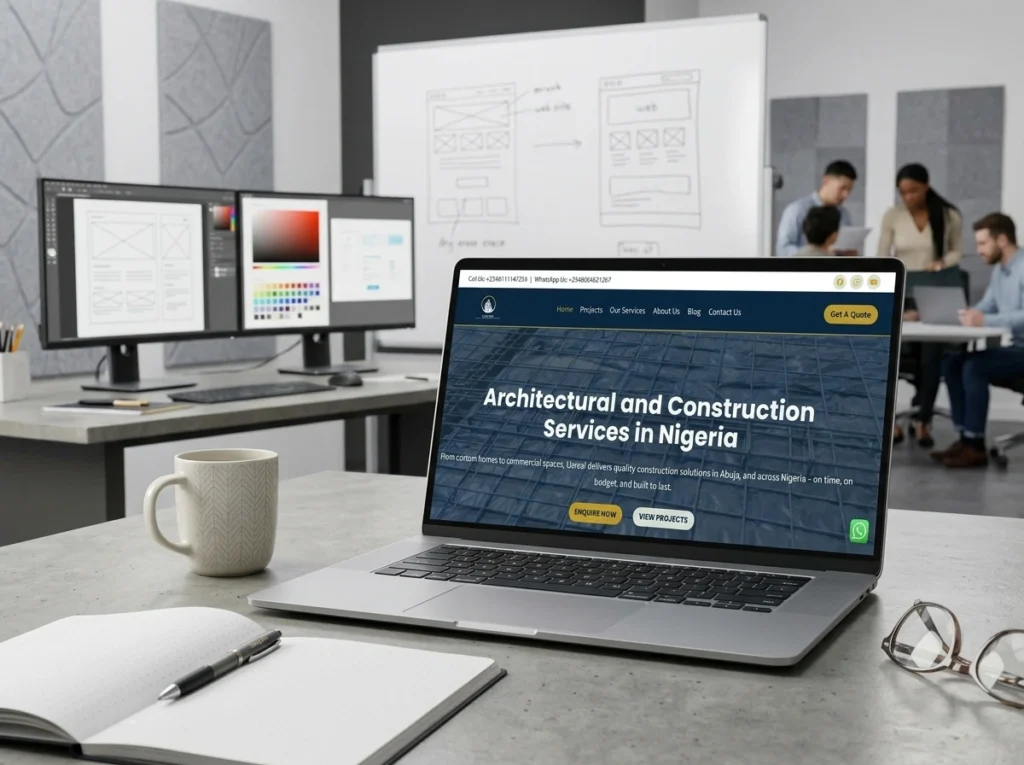
The client is an architectural and construction company based in Nigeria, serving both residential and commercial clients. Their core services include:
- Architectural design and drawings
- Building and construction services
- Building materials supply
They had been running their business and completing real projects. The work was there. The experience was there. The credibility was there. But none of that was visible online.
A potential client searching for construction services in Nigeria could not find them, could not see their work, and had no clear way to trust or contact them. That is a significant gap and the kind of gap that costs businesses actual money.
You can visit the live website here: uzreal.ng
The Problem: What Was Missing Before the Website
Before I came on board, the business had no strong online structure. Here is a breakdown of the specific gaps:
- No clear communication of services: Visitors who landed on their page could not immediately understand what the business does, who it serves, or why they should trust it.
- No showcase of past projects: In the construction industry, seeing real work builds real trust. There was no structured way to display the company’s completed projects.
- No clear path for potential clients: There was no structured journey from landing on the page to making an inquiry. Interested visitors had no obvious next step.
- Online presence did not match actual capacity: The business was doing quality work, but its digital presence was not communicating that to the outside world.
In simple terms: the business existed, but its online presence was not supporting its growth.
What I Built
I built a complete, service-focused website using WordPress, Gutenberg, and Kadence — designed with three priorities in mind: clarity, trust, and performance.
Pages Included
- Homepage: Structured to immediately communicate what the company does, who they serve, and how to take the next step.
- Services page: A clean breakdown of all three core service areas, written clearly for potential clients.
- Projects section: A dedicated showcase of real work, the most important trust-building element on a construction company website.
- About page: Designed to position the company as credible, experienced, and reliable not just to describe who they are.
- Contact page: Straightforward, mobile-friendly, and built to make inquiries easy.
- Blog section: Set up to support long-term SEO visibility and give the business a place to share expertise over time.
Tech Stack Used
- Platform: WordPress
- Builder: Gutenberg + Kadence
- Focus: Speed, simplicity, and ease of management for the client
I always build websites that the client can manage themselves after launch. You should not need to call your web designer every time you want to update a line of text.
The Challenges I Faced (And How I Solved Them)
I want to be honest here because this is something most web designers do not talk about.
No project is without challenges. What separates a professional from an amateur is not the absence of problems. It is how you respond when they show up.
Here is what I dealt with on this project, and what I did about it.
Challenge 1: No Brand Direction
There were no defined brand colors, no visual identity, and no design direction at the start of this project. The client came in with a business name and a list of services, not a brand.
I had to build a complete visual identity from scratch. This means choosing a color system, defining the visual tone, and creating a look that feels solid and professional, consistent with what clients expect from a serious construction company.
I did not just pick colors I liked. I researched what works in the construction and architecture industries, what builds visual trust, and what would look good for both residential and commercial clients. Then I built around that.
Challenge 2: No Content Ready
The client did not arrive with written website content. No homepage copy. No service descriptions. No about page text.
This is more common than people realize. Many business owners know what they do, but putting it into words that speak clearly to potential clients is a different skill entirely.
I took responsibility for this. I structured every page from scratch, thinking through what a potential client would want to know at each stage, what questions they would have, and what information would move them toward making contact. Then I wrote the content to answer those questions clearly.
This is something I include as part of my web design service, because a well-designed website with poor content still does not convert.
Challenge 3: Technical Roadblocks
During the build, I ran into several technical issues:
- Layout breaks: Certain sections were not rendering correctly across screen sizes.
- Header spacing issues: The logo placement and header spacing required multiple rounds of adjustment to get right.
- Plugin conflicts: A performance-related plugin was interfering with the layout in unexpected ways.
I did not panic, and I did not cut corners to move faster. I went through each issue methodically — isolating the problem, testing solutions, and confirming that the fix worked properly across devices before moving on.
This is the kind of thing that takes time. But it is also the difference between a website that looks polished and one that has small broken things that quietly damage a brand’s credibility.
Challenge 4: Design Precision with Gutenberg and Kadence
Getting certain layouts to look exactly right, image overlaps, consistent spacing, and proper responsiveness on mobile required real attention and repeated refinement.
Gutenberg and Kadence are powerful tools, but they are not magic. Achieving a clean, well-structured layout with them requires patience, an eye for detail, and a willingness to adjust things that are almost right until they are fully right.
I did not rush this part. Small design details, spacing, alignment, and how a section looks on a phone screen add up to the overall impression a website gives. I took the time to get them right.
This is what I mean when I say I build websites that serve a business purpose, not just websites that look like websites.
The Result
The business now has a website that does what a business website is supposed to do:
- Clearly communicates what they do – no confusion, no guesswork for visitors.
- Showcases real project work – building trust before a single conversation happens.
- Positions the company as credible and professional – matching the quality of the actual work they do.
- Makes it easy for clients to reach out – a clear, low-friction contact experience.
- Supports long-term visibility – the blog section is ready for content that will help them show up on Google over time.
This project was about turning a business with little online structure into one with a clear, professional, and reliable digital presence. That is exactly what we achieved.
What This Web Design Case Study Teaches Us
Beyond the client result, this project reinforced something I believe strongly about web design:
A website is a business tool, not a decoration.
The goal was never to build something that looks nice. The goal was to build something that works — something that takes a visitor from curiosity to confidence to contact.
Every page, every section, every word of content was placed with that goal in mind.
Structure matters more than visuals.
Before I thought about colors or fonts, I thought about structure. What does a visitor need to see first? What question do they have next? What would make them trust this business? The answers to those questions shaped the entire build.
Real challenges make real designers.
The brand direction I had to create from scratch. The content I had to write. The technical issues I had to debug. These were not obstacles that got in the way of the project. They were the project.
Any web designer can work when everything goes smoothly. What matters is what you do when something breaks at 11 pm and your client is waiting.
This project also grew me as a designer. It strengthened my ability to:
- Solve real-world web design challenges under pressure
- Think through structure, not just visual aesthetics
- Build websites that serve a real business purpose
Is Your Business in the Same Situation?
If you read through this case study and found yourself nodding, if your business has real services, real experience, and real capacity, but your website does not reflect any of that, then your situation is not unique.
It is one of the most common problems I see among Nigerian SMEs, professionals, and growing businesses.
The good news? It is completely fixable.
Ask yourself honestly:
- Does your website clearly communicate what you do within the first 5 seconds?
- Does it show proof of your work in a way that builds trust?
- Does it make it easy and obvious for a potential client to contact you?
- Does it reflect the actual quality and capacity of your business?
If your honest answer to any of those is no, that is where I come in.
Want a Website That Actually Works for Your Business?
I build websites for Nigerian SMEs, professionals, NGOs, and businesses that are ready to show up properly online.
Every project I take on gets the same attention you saw in this web design case study: clear structure, honest communication, real problem-solving, and a final product that serves your business long after launch.
My services include:
Business website design (1-page, 5–7 pages, WordPress, mobile-responsive, SEO-ready)
E-commerce and online store setup (WooCommerce, product pages, payment integration)
Monthly website care and maintenance (so your website stays fast, secure, and up to date)
Want to see more of my work before reaching out?
Visit: sitesbyamaka.com
Another client project: sloversfoundation.org.ng
Ready to talk about your project?
📩 Email: hello@sitesbyamaka.com
💬 WhatsApp: +2349021288276
Also read: Cost of Building a Website in Nigeria: The Honest 2025 Breakdown.